How I Rescued My Brain by David Roland
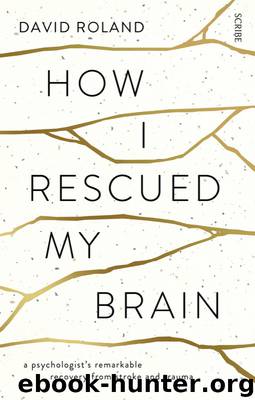
Author:David Roland
Language: eng
Format: epub
Tags: BIO026000, SCI000000, HEA000000
Publisher: Scribe Publications
Published: 2014-07-22T16:00:00+00:00
RECOVERY
12
IT’S SEVEN MONTHS post-stroke: February 2010. I’m anxious to get on with my recovery, and the more I read, the more it seems like a computer-based cognitive training program is what I need.
I ask Doctor Small about such programs, but he knows nothing about them. Then I ask Doctor Mercer, the ophthalmologist, if computer-based training would improve my visual deficit, but she’s not heard of this approach either. She recommends gentle exercise, such as walking along the beach, and tells me that I’ll see improvement with the passage of time.
Doctor Small has recommended a neuropsychological assessment, so I decide to put off ordering a program until I speak with the neuropsychologist. A standard assessment includes a clinical interview and a series of tests that aim to measure a person’s cognitive functioning, including short- and long-term memory (both verbal and visual), processing speed, spatial skills, conceptual thinking, decision-making ability, and learning capability. I am keen to know the extent of my cognitive capacities, like a high jumper wanting to know how high the bar can be set.
I call the neuropsychologist to let him know that I am a clinical psychologist and I have experience in neuropsychological testing. I’m aware that my prior knowledge of some of the tests might influence the results. He asks me what tests I’ve used in the past; he’ll find alternatives, he says, and thanks me for making contact.
On the day of my appointment, I meet him in his city office, which is quiet and comfortable. The assessment, including the interview, takes almost three hours, with a break in the middle. In one test, he recites a list of eight pairs of unrelated words and asks me to repeat them back to him. After the first trial, I correctly remember two of the eight word pairs. He repeats the list three more times, and after each trial, I repeat back the word pairs I can remember. By the end of the fourth trial, I have only learnt one extra pair — three all up. I’m trying really hard, but the words just don’t stick in my mind. This is the type of test I’ve given many times before, and I know that mine is a poor result: I should’ve learnt most of the pairs by now.
The neuropsychologist reads out two short stories. Then he asks questions about the content of the stories, and, some time later, asks me to recall as much as I can. Once again, my performance is poor, even though I think I’ve administered one of the stories myself in testing clients.
My memory for faces and my working memory (working memory typically lasts twenty to thirty seconds) are poor. My visual memory is good, and my vocabulary and speed of processing on visual tracking tests is in the superior range.
My uneven results across the different tests points to an organic cause for my cognitive deficits that’s consistent with a brain injury. The neuropsychologist says that the high level of chronic stress and my post-traumatic stress disorder could also have caused the cognitive deterioration.
Download
This site does not store any files on its server. We only index and link to content provided by other sites. Please contact the content providers to delete copyright contents if any and email us, we'll remove relevant links or contents immediately.
Waking Up in Heaven: A True Story of Brokenness, Heaven, and Life Again by McVea Crystal & Tresniowski Alex(37925)
Still Foolin’ ’Em by Billy Crystal(36468)
Cecilia; Or, Memoirs of an Heiress — Volume 1 by Fanny Burney(32721)
Cecilia; Or, Memoirs of an Heiress — Volume 2 by Fanny Burney(32089)
Cecilia; Or, Memoirs of an Heiress — Volume 3 by Fanny Burney(32066)
Fanny Burney by Claire Harman(26728)
Empire of the Sikhs by Patwant Singh(23205)
We're Going to Need More Wine by Gabrielle Union(19170)
Hans Sturm: A Soldier's Odyssey on the Eastern Front by Gordon Williamson(18724)
Plagued by Fire by Paul Hendrickson(17540)
Out of India by Michael Foss(17022)
All the Missing Girls by Megan Miranda(16711)
Cat's cradle by Kurt Vonnegut(15556)
For the Love of Europe by Rick Steves(14915)
Pimp by Iceberg Slim(14796)
Molly's Game by Molly Bloom(14260)
Bombshells: Glamour Girls of a Lifetime by Sullivan Steve(14219)
Leonardo da Vinci by Walter Isaacson(13516)
4 3 2 1: A Novel by Paul Auster(12614)
